Foundational Information Technology
The efficiency layer for the AI economy.
Make intelligence lighter before making infrastructure bigger.
General Harmonics develops patented information architecture designed to identify structure inside digital information and increase useful information density before that information consumes memory, bandwidth, compute and energy.
MSML provides the foundational representation. IDDO applies that structure to optimization. The objective is simple: preserve what carries information value while reducing unnecessary information burden.
More information value per byte. More intelligence per watt. More capability from existing infrastructure.
Why Now
AI does not have a demand problem. It has an efficiency problem.
Models are growing. Context is growing. Inference is scaling. AI agents add memory, tool calls, context exchanges and longer-running workflows. The result is increasing pressure on memory, accelerators, networks, data-centre capacity and power.
~$750B
Expected 2026 data-centre spending by Alphabet, Amazon, Meta, Microsoft and Oracle.
Source: Reuters / Breakingviews~$1.09T
Future lease commitments disclosed by major technology companies, largely tied to AI-driven data-centre expansion.
Source: Reuters~950 TWh
Projected global data-centre electricity consumption by 2030 — roughly double 2025 levels.
Source: IEAEvery unnecessary byte has a downstream cost.
Information efficiency is an added optimization layer on top of the infrastructure already required.
The Economic Mechanism
Structure changes what information costs.
Digital information is not free once it enters a system. It must be stored, moved, held in memory, processed, and often transmitted across networks. Each step consumes infrastructure and energy. We work on the representation of that information before those downstream costs accumulate.
Reduce unnecessary information burden upstream. Change downstream resource demand.
We ask an earlier question: how much information burden actually needs to enter this chain in the first place?
Hardware makes computation faster. We work on making the information being computed lighter.
The infrastructure it travels through
Technology Foundation
A foundational architecture — structure first, then density.
We represent information as multi-structural, multi-level relationships, then reduce what has to be stored, moved and computed — optimizing the output for the task at hand without losing what matters.
Multi-Structural, Multi-Level
A patented information formalization architecture that represents information through structures, relationships and multiple levels — rather than treating it only as a flat stream of data.
Intelligent Data Density Optimization
An applied methodology that uses structural representation to increase useful information density while preserving the information required by the task.
MSML identifies and represents structure. IDDO uses that structure to optimize information burden.
More useful information per byte, not simply fewer bytes.
The objective is not reduction for its own sake. It is to preserve the information that carries value while reducing unnecessary informational burden.
Smaller data alone
is not the objective
Higher useful information density
is the objective
From Foundational IP to Customer-Specific Solutions
Every pipeline is different. The optimization architecture should respond to the pipeline.
One enterprise may be constrained by model memory. Another by inference cost. Another by long-context traffic, RAG, multimodal data, edge-device limits or agent-generated context. Within a single enterprise, several of these constraints may exist at once.
We are developing an AI-assisted orchestration capability designed to apply MSML / IDDO selectively to the customer’s actual information pipeline.
MSML Solution Engine — In DevelopmentFoundational technologies can apply broadly, but they are difficult to scale commercially when every enterprise architecture is different. The developing MSML Solution Engine is intended to bridge that gap by translating one foundational architecture into many specialized implementations.
Customer pipeline
Models · RAG · Agents · Databases · Multimodal data · Networks · Edge
Apply MSML / IDDO where it creates value. Not everywhere by default.
One foundation. Thousands of pipelines. Thousands of possible MSML solutions.
AI & Data Centres
Make intelligence lighter before making infrastructure bigger.
As models, context windows and agentic workloads grow, more of the burden sits in how weights, working sets, activations, context and intermediate information are represented, stored and moved across memory, accelerators and networks. MSML / IDDO addresses the information layer beneath that stack — reducing unnecessary information burden while preserving the information required by the workload.
The objective is not to replace GPUs, HBM, networks or cloud infrastructure. It is to reduce the information burden those systems must carry and process.
Where it is relevant
Increasing capability often requires more memory, bandwidth and centralized infrastructure.
More intelligence must fit within constrained memory, bandwidth, power and connectivity.
Increasing useful information density may help make more capable local intelligence practical within constrained environments — connecting the same architecture to robotics, autonomous systems, telecom, sovereign systems and embedded intelligence.
Measurable Value
Technical efficiency only matters when it changes the economics.
We evaluate information efficiency through measurable technical KPIs, then connect those changes to the operating resources they influence. The relevant metrics depend on the customer pipeline and must be validated against a defined baseline.
What we measure
Information volume
Bytes represented, stored or moved
Memory footprint
Model footprint, working sets and context / KV memory
Network load
Traffic and bandwidth requirements
Compute workload
Processing burden and accelerator workload
Latency
Task, inference or pipeline response
Energy
Energy associated with processing and moving the workload
What it may change
More workload capacity from existing infrastructure
Lower compute or inference cost
Reduced cloud, storage or network burden
Deferred infrastructure expansion
Greater edge feasibility
Lower energy requirement
Technical KPI → infrastructure effect → economic effect
- Lower network traffic → less bandwidth burden → lower transmission cost / more capacity
- Smaller working set → lower memory pressure → more workload capacity
- Lower compute burden → fewer processing resources per workload → lower operating cost
Evidence status — used wherever claims appear
Validated
Measured under defined test conditions.
Demonstrated
Observed in GH / PulsBeat implementations.
Target
Acceptance objective currently under validation.
Modelled
Scenario based on stated assumptions.
In development
Planned capability not yet production-ready.
Measure the information burden. Validate the technical change. Translate it into economic value.
From Foundation to an Industry Stack
PulsBeat shows how foundational information architecture becomes applied technology.
Media became an early major implementation environment for our foundational work. Through PulsBeat Media, the architecture progresses from information principles into specialized technologies, infrastructure, platforms and commercial experiences.
Information
The same foundational information object established at the start.
The Acoustic Intelligence Stack
Five technologies. One structured representation of sound.
D1 AUDIO
AudioDNA
LiveLink
LDE
cDM Cloud

Platforms & Experiences
PulsBeat demonstrates the progression from foundational IP to applied technology, infrastructure and commercial experiences. It should be understood as proof of translation, not as the limit of the GH architecture.
Explore PulsBeatWhere the Architecture Applies
One architecture. Multiple information environments.
The information changes from industry to industry. The recurring constraints often do not: volume, memory, bandwidth, compute, latency, energy and complexity.
The industries change. The economic denominator does not: information still has to be represented, stored, moved and processed.
Primary application environments
Extension environments
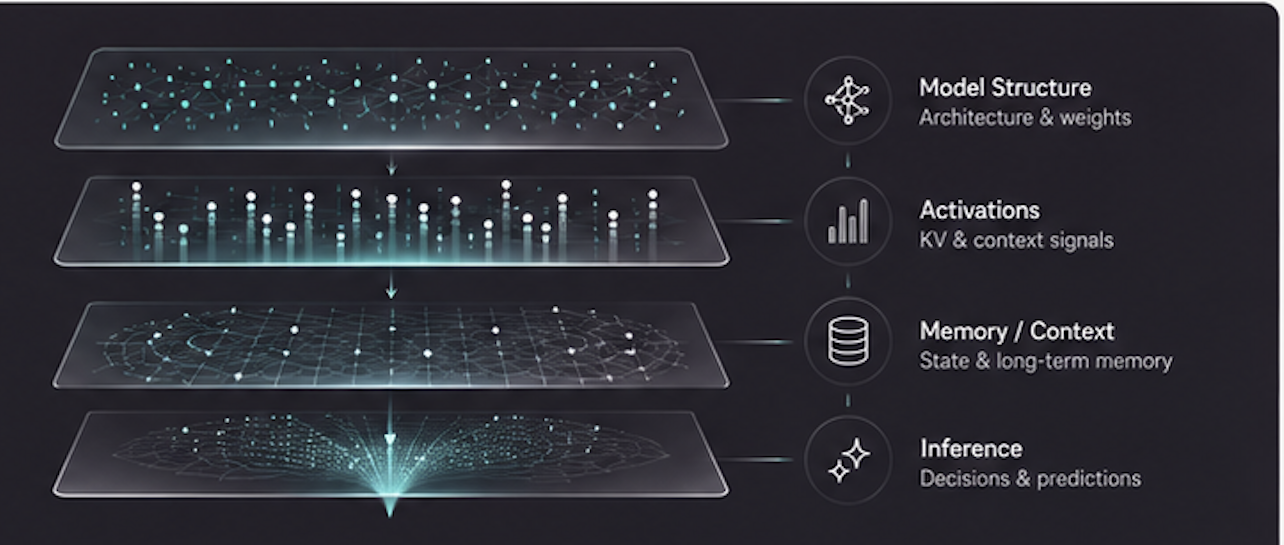
AI & Machine Intelligence
Modern AI depends not only on computation, but on how efficiently models, memory, context and information flows are represented.
- Model representation & weight structure
- Activation and KV / context structures
- Memory efficiency across inference
- Edge, multimodal and model distribution
Sovereign & Edge AI
Some AI workloads cannot depend indefinitely on centralized infrastructure. Memory limits, bandwidth constraints, intermittent connectivity, infrastructure availability and data-location requirements can make local processing strategically important.
MSML / IDDO may help increase useful information density so that more capable intelligence can operate within constrained local infrastructure.
Potential relevance
Application relevance depends on the information pipeline, workload and validation criteria of each environment.
Protected Technology Foundation
A defensible architecture, from foundation to application.
Our intellectual-property estate extends from foundational information formalization into applied technology families and additional fortification inventions.
Foundational IP
MSML and related information formalization.
Granted · Filed / Pending
Applied IP
Media representation, synchronization, recognition, identity and distribution families.
Filed / Pending · Provisional
Emerging / Fortification IP
Additional inventions and prepared filings extending the core architecture.
Provisional · Prepared for Filing
The value of the estate is not only in individual patents, but in the layered relationship between foundational architecture, applied implementations and continuing fortification.
Status reflects current filing stage. Inventions prepared for filing are shown distinctly and are not represented as filed.
MSML Solution Factory
One foundational architecture. Many customer-specific implementations.
The commercialization challenge for foundational technology is that every enterprise architecture is different. We are building toward a more systematic way to translate MSML / IDDO into specialized implementations for individual customer pipelines.
The developing Solution Engine is intended to make that translation increasingly repeatable, measurable and scalable.
Without a translation layer, broad foundational technology can require extensive custom engineering for every implementation. The MSML Solution Factory is intended to reduce that friction by creating a repeatable path from foundational architecture to validated customer solutions.
Commercial Paths
How organizations can work with us.
Technology Licensing
License foundational or applied GH technology into third-party systems and platforms.
Enterprise Pilots
Evaluate MSML, IDDO, MSML-LLMC or Acoustic Intelligence against real workloads, define measurable acceptance criteria and determine the path to deployment.
Applied Platforms
Extend value through PulsBeat Media, Acoustic Intelligence, AudioMine and related application environments.
Strategic Development
Joint development, integration, strategic partnerships and other structured technology-development opportunities.
Enterprise Engagement
Bring us your information bottleneck.
Tell us where information becomes expensive. We evaluate the pipeline, identify the constraint, establish measurable acceptance criteria and determine where MSML / IDDO may create the greatest technical and economic value.
The starting point is not the technology. It is your actual information pipeline and the constraint that matters most.
Pipeline
Models · RAG · Agents · Multimodal workloads · Data pipelines · Networks · Edge
Constraint
Memory · Bandwidth · Compute · Context · Storage · Latency · Energy
Baseline
Establish the current technical and economic baseline before optimization.
Target KPI
Define the acceptance criteria before testing.
Pilot
Validate against the real workload, then decide the path to deployment, licensing or further development.
Different industries. The same underlying information challenge.
AI models, data centres, networks, media platforms, machines and connected systems all depend on how efficiently information can be represented, stored, moved and processed. General Harmonics works at that foundational layer.
More information value per byte. More intelligence per watt. More capability from existing infrastructure.